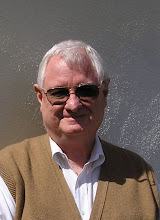
Most veterans, returning home at the conclusion of WWII, were determined to make the American dream a reality. Thousands of homes were built in the San Fernando Valley, and many young vets, like Joe Hosler and Jim Fecht started their own businesses. Jim and Joe bought a pickup truck, acquired electrical contractors' licenses, and opened up shop. These images were among the effects donated to The Museum by James Fecht just before his death. (click on images to enlarge)
Photo 2722 - Pickup truck belonging to James Fecht and Joseph Hosler - 1949
Photo 2721 - left Joe Hosler, right James Fecht with their new truck. 1949 - North Hollywood, gift to The Museum of the San Fernando Valley from Jim Fecht 2009.
Photo 2723 - James Fecht in North Hollywood, California in 1949. The location was on Elmer Avenue, an area removed for the construction of the 101 freeway. Jim was a World War II Marine.
Showing posts with label James L. Fecht. Show all posts
Thursday, April 21, 2011
Wednesday, January 6, 2010
JAMES FECHT AND MICHAEL FETTERHOFF

Jim Fecht was very proud of his grand-nephew Thomas Fetterhoff, who visited him during his time in California as a United States Marine. Jimmy was interested in all things Marine, and was fascinated with how his beloved Corps had changed since his service during the Second World War. Jim died this last year and we had a government bronze plaque put over his grave.
James Fecht was the g-great grandson of Mary Ann (Secrist) and Josiah Crites, the grandson of Leona Belle (Weaver) and John Franklin Crites, and son of Mildred (Crites) and William T. Fecht. He was the great grandson of Elizabeth Ann (Paugh) and John S. Weaver of Oswego, Indiana.
Michael Fetterhoff is the g- g-g-great grandson of Mary Ann (Secrist) and Josiah Crites, the g-g- grandson of Leona Belle (Weaver) and John Franklin Crites, great grandson son of Mildred (Crites) and William T. Fecht, grandson of Dorothy and Elmer Fetterhoff. He was the g-g-g- grandson of Elizabeth Ann (Paugh) and John S. Weaver of Oswego, Indiana.
In 2010 Michael Fetterhoff is living in Florida.
Friday, March 27, 2009
V-MAIL FROM THE FRONT - WORLD WAR II
V-Mail April 1944 (click on image to enlarge)During the Second World War, to minimize the weight of transporting the mail, "V-Mails" were introduced to carry short messages from soldiers on the front lines to their homeland. Some kind of micro-filming process was used. I think that perhaps little cartoon messages were provided military personnel, such as this Mother's Day V-Mail from Jim Fecht to his mother Mildred Crites Fecht in Mexico, Missouri. April 1944
Labels:
1944,
James L. Fecht,
Mildred Crites,
V-Mail
Monday, February 23, 2009
MORE OF JIM FECHT'S MEMORIES OF IWO JIMA
Scrapbook Clipping 1845 - Mexico, Missouri - Archives of The Museum of the San Fernando Valley - 2009 (click on image to enlarge)The following is a handwritten account by our kinsman the late James L. Fecht.
"One of the guys in our outfit was killed by rifle fire and we buried him in a shallow grave and stuck his rifle with a bayonet on it in the ground with his helmet and dog-tags on to mark the grave sit as we moved on up thru the lines. After the fight was over two of us wee sent back to bring his body back to a grave registration outfit. On the way back I was walking ahead and tripped a booby trap wire that was hooked to a grenade in a small scrub tree just at the height of my head. My buddy hit the deck behind me but I sensed it was too late for me, so I just stood there cursing my luck with the grenade went off and I realized it was just a Jap phosphorous grenade that was used to light up the area at night to see anyone passing that way. I was a nervous wreck for several days after that.
A Jap artillery shell hit a bluff about 10 yards form my buddy and me as we were dug in a fox hole below. When it went off it covered us with dirt and dust. a pill box 200 yards ahead of us knew we were there and kept us pinned down with a lite Nambu machine gun until a tank moved us and silenced them.
We could not sleep for the first few nites but then exhaustion crept in and we could take times sleeping while one kept watch, the other slept, even with the shells bursting all around.
Our secret to advancement was overpowering fire power. Continuous bombardment with all we had. Once we moved past the first airfield, we were able to bring in rocket launchers, artillery and tanks to help us progress. The well fortified pill boxes of reinforced concrete covered with dirt were our biggest problem. They were so placed that they covered each other's flanks. As a tank would move in toward me it would be knocked out by an unseen pill box from its flank firing 47 m.m. anti-tank high explosive shells. We had to take extra caution while going in with a tank as these shells burst all around us.
One pill box had us pinne down with machine gun fire so we couldn't cross an open spot to get to it, and one our guys an Indian boy from Montana by the name of Mix crawled almost 100 yards under the fire and lobbed a grenade thru the port hole slit in the pill box, killing all inside and letting advance another 100 yards. I think he got the silver star for that action but I never heard for sure.
Almost two thirds of the way up the Island we were paired off in twos in our sandy fox holes and a one guy kept watch the other could sleep. Our sleep was forever getting interrupted by someone slipping along crawling toward our supplies of food and water, and by the eerie light of our flares -shooting was sporadic all night. Toward the end though we would be rushed by groups of 10, 20 and 100 trying to break out resulting in viscous fire fights.
One day my buddy from New York, Homer Davis and I got pinned down and couldn't get out of our fox hole. The Japs were firing all the mortars and rockets they had left and were keeping us pinned down. All we had to eat was canned cheese. We ate cheese for two days.
We had a wicked fire fight one night about 2 AM. About 400 Japs charge thru a thicket of small trees just ahead of us right at our front line. The brunt of the chare hit the 4th Marines on our right and almost a 100 headed into us. We fired at every shadow from the flares overhead for about 2 hours and then it tapered off to just an occasional burst of fire here and there. Next daylight we scouted on up three trees and saw dead bodies stacked up like cord wood in front of us. The closest in front of me had a beautiful cow hide pack and a Jap flag inside his helmet. I still have his pack but lost the flag after all these years.
We followed the flame-throwers on up the Island as they fired into the hundreds of caves, and we fired as they scrambled out of their holes like ants.
When we reached the farthest point of the Island all organized resistance was over and it was just mopping up and blowing up the caves and pill boxes. Our company captain gave me a dispatch case with information on all the guys in our outfit that had been killed or wounded and was told to catch the first boat going back to Guam and deliver the information to our Regimental Headquarters back there.
I caught a LCVI (Landing Craft Vehicle Infarty?) and we sailed back to Guam. I caught a ride with a truck headed over to the other side of the island where our rear echelon was still in camp. The truck let me off at the front of a palm grove and I started walking back up to our tent city. When the group that were left behind in our rear echelon saw me coming up the road alone a cry went up and the guys came running down the road to meet me saying, "Where is the rest of the outfit?" "Are you the only one left Fecht?" "We've been listening to the battle on the radio, did everyone else get killed?" It took me a few minutes to quiet them down and reassure them that most of our buddies made it ok.
The Battle of Iwo Jima gave me enough combat points to gain a furlough back in the Sates and home for awhile. I s
Friday, February 20, 2009
JAMES FECHT'S MEMORY OF FEB. 20, 1945
Clipping from WWII scrapbook kept in Mexico, Missouri - Archives of The Museum of the San Fernando Valley - 2009Memoirs of James L. Fecht - 3rd Marine Division - WWII -
"After a few months of relaxation after the Guam landing, we began training for our next objective. Tokyo Rose, who usually knew somehow about where we were going next, began broadcasting from Japan that our 3rd Marine Division was going to make a landing in Okinawa and that most of us would be killed. She was really wrong on that one, as we were headed for Iwo Jima in the Volcano Islands.
Our 3rd marine Division was met with the 4th Division from Hawaii and the 5th Division from Saipan and at sea. We rendezvoused with an escort of destroyers and various battleships along with an ominous pair of red cross hospital ships that gave us the willies.
We listened to the bombardment by sea and air thru our attack troop ship radio and learned of our destination. We studied maps and held school on the battle plan which didn't hold much imagination for such a tiny island. The plan was for the 5th Division to land first and head straight across the island, the 4t Div. was to land second and go up the right side of the island and then our 3rd Division was to land and go up the center of the island, with the 5th on our left and the 4th on our right.
I dug in the soft sand and looked up at the volcano Mount Suribachi that commanded all the high ground let them look right down our throats.
Destroyers, battleships, cruisers and small gun boats pounded away at the mountain and dive bombers blasted them from above, but just the minute the dust would clear for a second, out of a cave would poke a shore battery gun and cut loose at the ships and down along our beach."
Clipping from WWII scrapbook kept in Mexico, Missouri - Archives of The Museum of the San Fernando Valley - 2009
Labels:
1945,
Iwo Jima,
James L. Fecht,
World War II
Wednesday, February 18, 2009
JAMES FECHT - SOUTH PACIFIC AT PEACE PAINTINGS
Photograph of Iwo Jima (click on image to enlarge) Archives of The Museum of the San Fernando Valley James Fecht was a U.S. Marine who fought on Iwo Jima with the 3rd Marine Division. The following is an excerpt from his war memoirs. In the final years of his life, Jim began a series of acrylic paintings of the places where he had fought. He painted all of the locations at peace. It took him a lifetime to work through the terrors he had experienced in combat.
page 98
"Things started heating up about 200 yard ahead of us in the scrub trees and volcanic rocks, a firefight was definitely moving our way. Homer Davis, a farm boy from Middlefield, New York and I were huddled up as deep as we could get in a shell hold, in the light volcanic sand, about 20 yards from the edge of the scub trees.
The unmistakable crackling of light Namu machine gun fire, and the popping of their rifle fire, kept coming our way, and we knew that we would soon be in for it. Mortar shells were dropping in on us, ahead of their advancing troops, keeping us pinned down in our holes.
Every time a shell exploded nearby, the light sand would shift back down in our hole, keeping us busy shoveling it out again. We took turns immediately after a shell burst, to stick our heads up to take a peek at what was coming our way, and then report to the other what we thought was coming in.
At my lst sighting it appeared to me that the shells were bursting further behind us, which meant that their troops were getting closer to us. I also note that their small arms fire was moving a little further to our right into the 4th Marines on our right flank.
Our Battalion's plan on defending or advancing was always to lay down a withering stream of fire, and the time had come to defend our position against their counter attack. They were too close for our artillery or Naval or Air support, so that left it up to each of us to throw everything we had at them.
On all sides of us, all up and down the line, small arms fire began popping and cracking, and with the explosions of grenades and mortar shell, it sounded like the biggest Fourth of July you've ever heard.
page 99
It was pretty late in the afternoon and with the sun going down, we were sure that their main charge would come after dark. Their counter attacks always came after they moved up close to our positions during the day, then came in on us at night.
Our old Marine Gunner McGrew, a 20 year veteran who we would follow anywhere, came crawling into our hole with bandoliers of 30 caliber ammo clips for our rifles, and bags of grenades. He told us to keep our fire all night, but to fire from different positions so as not to give our locations away.
Homer crawled about 5 yards to the left and I crawled 5 years to the right, were we dug a couple more foxholes in the sand to give us a couple of more firing positions. We would fire into the scrub trees ahead whenever we thought we saw something moving. And, the rest of our battalion were doing the same thing.
As it got dark, one of our destroyers moved in close to shore, and started shooting off flares that lit up the area in an eerie light as they slowly drifted to the ground. In the dust and smoke from exploding shells rising up in the brush and scrub trees, limbs were being cut off from the murderous fire. Shadowy figures darting between rocks and trees drew a stream of fir from a dozen different directions.
When the sand started kicking up in my face, I realized that there was incoming fire too. I could hear the whizzing over my head that sounded like bees buzzing by. The Gunner came crawling by, dragging more bandoliers of ammo from hole to hole.
page 100
The firing in front of us died down about 2 A.M., but it sounded like the 4th (division) on our right flank were still getting it. They were in afire fight and were getting mortar shells dropped in on them too. The shelling lasted only about a half hour, but there was to be no sleep that night, as small bands of three or four charged our lines all night. The tension in the darkness was sheer terror and left us all exhausted as first light of dawn filtered through the dust and fog.
Homer and I took turns cat-napping and keeping watch back in our big sandy hole together. Lieutenant Rink crawled over to us and passed the word that we were to move out right away, and move up 100 yards and dig in there. We strapped our packs on, loaded up our cartridge belts with ammo, hooked on all the grenades we could carry, then crawled out of our holes.
About 20 feet to my left, a big ex-Pro football player named Gurley, lay slumped over the edge of his foxhole. I thought he was just asleep, and I crawled over to wake him and to get him to come with us. That's when I noticed his mouth and nose were buried right down in the sand. It looked like somewhere during the night he must have raised up to fire, a small piece of shrapnel hit him right in the heart. Our Navy Corpsman, Doc Wilson, got my signal and crawled over to take at look at him, but there was nothing he could do.
page 101
As we made our way up to our new position, we encountered dead enemy bodies about 20 yards in front of us. That's how close they had gotten to us. When I poked one with my bayonet to make sure he was dead, his helmet fell off, and I found some letters, pictures, and a regimental flag up on the inside straps of his helmet. I stuffed them into the pockets of my dungarees, and moved on.
As we got further into the scrub trees, we found dead bodies all over the place, some places they were stacked on top of each other. They had charged right into our murderous firepower. Some of the guys were shooting into the corpses, taking no chance that some might be alive.
The Artillery, Naval and Air bombardment ahead of us, churned up the landscape until it looked like all the pictures of hell I had ever seen. s the barrage moved on up ahead of us, we came out of the little scrub trees into a small clearing, where we stopped and started digging in, and not a bit too soon! a machine gun opened up from a concrete pill box about 200 yards ahead of us, spraying lead all across the front lines. When bullets started kicking up dust all around you, and clipping off the leaves from bushes right near your head, you can dig a hole pretty fast.
A take was called up to knock out the pill box that was pinning us down, and as it swung into the clearing, and started firing at the emplacement with armor piercing shells, some of those shells ricocheted off the concrete and bounced end over right over our heads adding to our peril.
page 102
The tank maneuvered in closer to the pill box to get within its flame thrower range, when all of the sudden it was hit by a high explosive shell from another buried pill box on its flank. The tank was completely immobilized and started burning. A couple of the tank crew got out of the tank and started running town our lines, but both bunkers opened up on them and cut them down.
About 20 yards on my right, an Indian boy from South Dakota, by the name of Mix, stripped off his pack, cartridge belt and canteens, loaded up the pockets of his dungarees with grenades, grabbed his rifle and took off on a dead run toward the bunker, about 200 yards of open ground.
I don't think they saw him because the smoke from the burning tank, because he never drew any fire at all. He ran around to the back of the dirt mound that covered the concrete pill box and started throwing in grenades one after the other, as fast as he could pull the pins. When the dust cleared Mix waved at us and yell that it was all clear. There were 4 dead bodies in the bunker and Lieutenant Rinka said we could more up past there tomorrow.
After the campaign of Iwo Jima was over, we returned to our base on Guam, where Mix was awarded the Silver Star for his outstanding bravery. "
South Pacific at Peace Series by James L. Fecht (click on image to enlarge) Acrylic painting completed in 1997. Archives of The Museum of the San Fernando Valley 2009
Sunday, September 14, 2008
MORE ABOUT JAMES FECHT ON IWO JIMA
(click on images to enlarge) 
Currency from WWII - Gift from James L. Fecht to The Museum of the San Fernando Valley 2007 (click on image to enlarge)
Two (likely) Japanese bills given to his Museum by James Fecht just before his death. Jim acquired these bills on Iwo Jima at the same time he got the Philippine note.
JAMES FECHT on IWO JIMA
James Louis Fecht was the great grandson of Mary Ann (Secrist) and Josiah Crites. He served as a U.S. Marine in the South Pacific during World War II.
Philippine 10 centavo note: Gift to The Museum of the San Fernando Valley by James L. Fecht in 2007
James Fecht, a young American Marine in World War II brought back several interesting artifacts, one of which is this small 10 centavo note from pre-World War II Philippines. The bill was found on a Japanese soldier captured during the invasion of the Island of Iwo Jima. Japanese prisoners, and there were very few on Iwo Jima, were stripped and made to lay under barbed wire. Artifacts in their clothing not deemed of military significance were divided among the young Americans guarding the prisoners.
Archives of The Museum of the San Fernando Valley (click to enlarge)
After WWII, James Fecht married and settled in the San Fernando Valley. It was years before he talked about his experiences in the war, among which was the guarding of prisoners on Iwo Jima. He talked about how much he hated the prisoners, and how he feared them. Jim had seen the results of the Japanese army's atrocities on other islands and the deaths of his friends and fellow Marines. His indoctrination about the "sub-human" status of the Japanese made him more fearful, dangerous and determined.
Philippine 10 centavo note: Gift to The Museum of the San Fernando Valley by James L. Fecht in 2007James Fecht, a young American Marine in World War II brought back several interesting artifacts, one of which is this small 10 centavo note from pre-World War II Philippines. The bill was found on a Japanese soldier captured during the invasion of the Island of Iwo Jima. Japanese prisoners, and there were very few on Iwo Jima, were stripped and made to lay under barbed wire. Artifacts in their clothing not deemed of military significance were divided among the young Americans guarding the prisoners.
Archives of The Museum of the San Fernando Valley (click to enlarge) After WWII, James Fecht married and settled in the San Fernando Valley. It was years before he talked about his experiences in the war, among which was the guarding of prisoners on Iwo Jima. He talked about how much he hated the prisoners, and how he feared them. Jim had seen the results of the Japanese army's atrocities on other islands and the deaths of his friends and fellow Marines. His indoctrination about the "sub-human" status of the Japanese made him more fearful, dangerous and determined.
Tuesday, June 10, 2008
JANNE AND JERRY FECHT
Saturday, April 26, 2008
PATRIOTIC FLAG MADE BY LEONA CRITES
To see a World War II military service flag made by Leona Belle (Weaver) Crites, go to the blog of The Museum of the San Fernando Valley
http://museumsanfernandovalley.blogspot.com/2007/12/world-war-ii-family-window-flag.html
Labels:
James L. Fecht,
Leona Belle Crites,
Weaver,
World War II
Subscribe to:
Posts (Atom)